Mapping the European market for CO₂ transport by ship for 2030
[caption id="attachment_7896" align="alignright" width="512"]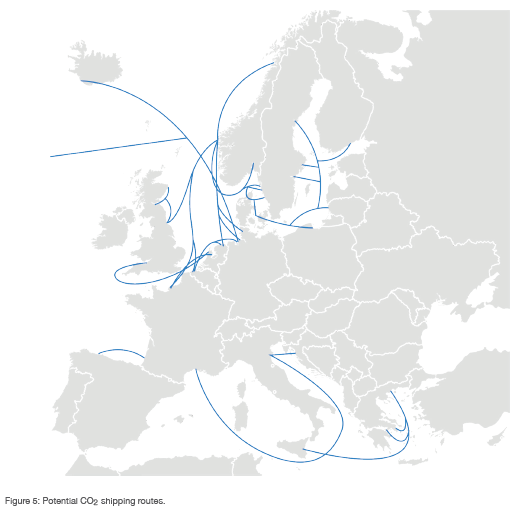 Figure 5 of the report describes potential CO₂ shipping routes as described in the various project proposals announced over the last few years.[/caption]
CO₂ transport by ship is an integral part of deploying the full CCS value chain across Europe and is critical for industrial decarbonisation. With a steady stream of new CCS projects, the report sought to define the scope of the CO₂ shipping market to understand how to create the right conditions for its deployment.
Based on findings, between 10 and 20 vessels could be built by 2030 to transport CO₂ for permanent storage. This estimation is based on a 20,000 cubic metre ship transporting approximately 1 million tonnes of CO₂. It is also estimated that CO₂ transportation could be scaled up to 39.5 million tonnes of CO₂ by 2030. Initially, the vessels are likely to be built on a project-by-project basis with vessels dedicated to transporting CO₂ from specific emitters to a specific storage location.
A total of 26 CO₂ storage projects at varying stages of maturity have been identified as potential contenders for CO₂ shipping. Of these, six projects totalling a maximum of 15 million tonnes storage capacity are explicitly planning to use shipping to transport CO₂ to a reception port by 2030.
The report shows that, in contrast to the United States or China, CO₂ shipping is expected to play a more significant role in Europe due to its geographical characteristics. Leading European projects are progressing their plans regarding CO₂ carriers, in addition to CO₂ terminals, for loading and unloading CO₂ from both the emitter as well as storage side. However, the development of this value chain will depend on funding incentives or market-based measures put forward by the EU and national governments to reduce industrial CO₂ emissions (e.g. the EU and UK ETS).
For instance, several governments in north-west Europe have decided to incentivise the creation of clusters (e.g. the UK, the Netherlands, and Denmark), which have stimulated the development of CO₂ hubs and cluster projects.
Figure 5 of the report describes potential CO₂ shipping routes as described in the various project proposals announced over the last few years.[/caption]
CO₂ transport by ship is an integral part of deploying the full CCS value chain across Europe and is critical for industrial decarbonisation. With a steady stream of new CCS projects, the report sought to define the scope of the CO₂ shipping market to understand how to create the right conditions for its deployment.
Based on findings, between 10 and 20 vessels could be built by 2030 to transport CO₂ for permanent storage. This estimation is based on a 20,000 cubic metre ship transporting approximately 1 million tonnes of CO₂. It is also estimated that CO₂ transportation could be scaled up to 39.5 million tonnes of CO₂ by 2030. Initially, the vessels are likely to be built on a project-by-project basis with vessels dedicated to transporting CO₂ from specific emitters to a specific storage location.
A total of 26 CO₂ storage projects at varying stages of maturity have been identified as potential contenders for CO₂ shipping. Of these, six projects totalling a maximum of 15 million tonnes storage capacity are explicitly planning to use shipping to transport CO₂ to a reception port by 2030.
The report shows that, in contrast to the United States or China, CO₂ shipping is expected to play a more significant role in Europe due to its geographical characteristics. Leading European projects are progressing their plans regarding CO₂ carriers, in addition to CO₂ terminals, for loading and unloading CO₂ from both the emitter as well as storage side. However, the development of this value chain will depend on funding incentives or market-based measures put forward by the EU and national governments to reduce industrial CO₂ emissions (e.g. the EU and UK ETS).
For instance, several governments in north-west Europe have decided to incentivise the creation of clusters (e.g. the UK, the Netherlands, and Denmark), which have stimulated the development of CO₂ hubs and cluster projects.
Assessing the interoperability of CO₂ transport by ship
In some cases, CO₂ will be transported via a multi-modal CO₂ transport network which could include a mixture of pipelines, trucks, barges, and ships. This means that the CO₂ can encounter a variety of elements (H₂O, NO₂, SO₂, H₂S, O₂), impacting the purity of the CO₂ which may then require additional processing at the port prior to loading onto a ship. Establishing hubs with CO₂ treatment facilities at points where the transport mode changes would be more effective than fulfilling all constraints of each transport mode. The report recommends focussing the early technical phase on the impurities that are most likely to mix in with CO₂ and which could cause corrosion or other chemical reactions. It therefore reiterates the CCUS Forum’s recommendation to develop a network code and standards for a multi-modal CO₂ transport network in the EU/EEA.Identifying barriers and enablers for the commercialisation of CO₂ transport by ship
There are a few regulatory and commercial barriers to unlocking the full potential of CCS. Therefore, the report highlights elements of applicable legal frameworks that require further attention to incentivise transboundary transport and sub-seabed storage activities within Europe, as well as between European and non-European countries. These include the following:- Countries party to the London Protocol should deposit a notice to provisionally apply the Article 6 amendment to the London Protocol with the International Maritime Organisation and sign bilateral agreements.
- The EU and UK should enter into an agreement to ensure emitters located in either region do not have to surrender ETS allowances when storing CO₂ in the others’ ETS system. The current disconnect between the EU ETS and UK ETS impedes import and export opportunities which hinder CCS and CCU scale up activities.