The first phase of the Industrial Decarbonisation Bank, the “ETS Investment Booster”, aims to mobilise around €30 billion to support the deployment and scale-up of industrial decarbonisation projects, backed by 400 million EU ETS allowances between 2028 and 2030. But where will these 400 million allowances actually come from?
The Industrial Decarbonisation Bank (IDB) was announced in the Clean Industrial Deal in February 2025 as a new EU financing instrument to accelerate investment in industrial decarbonisation. The Commission initially envisaged mobilising around €100 billion, drawing on resources from the Innovation Fund, additional ETS revenues, and the revision of InvestEU.
The July 2026 EU ETS Review proposal now gives the IDB a more concrete financing architecture, centred on the auctioning of 800 million EU ETS allowances (EUAs) across two successive phases.
Crucially, the allowances used to finance the IDB would come from within the existing ETS cap, rather than being created in addition to it. For Phase 1, the Commission proposes to repurpose 400 million EUAs from existing Phase IV (2021–2030) allowance pools: first from any allowances remaining in the free-allocation buffer and, where these are insufficient, from the New Entrants Reserve (NER).[1]
This blog unpacks that mechanism and examines how the ETS proposal would reinforce the NER. It then compares the reserve’s potential remaining balance with historical demand and previous Commission analysis to assess whether such a sizeable withdrawal could compromise the NER’s original purpose.
A two-phase Industrial Decarbonisation Bank
The Commission proposes to establish the Industrial Decarbonisation Bank from 2028, with a total endowment of 800 million allowances split across two phases
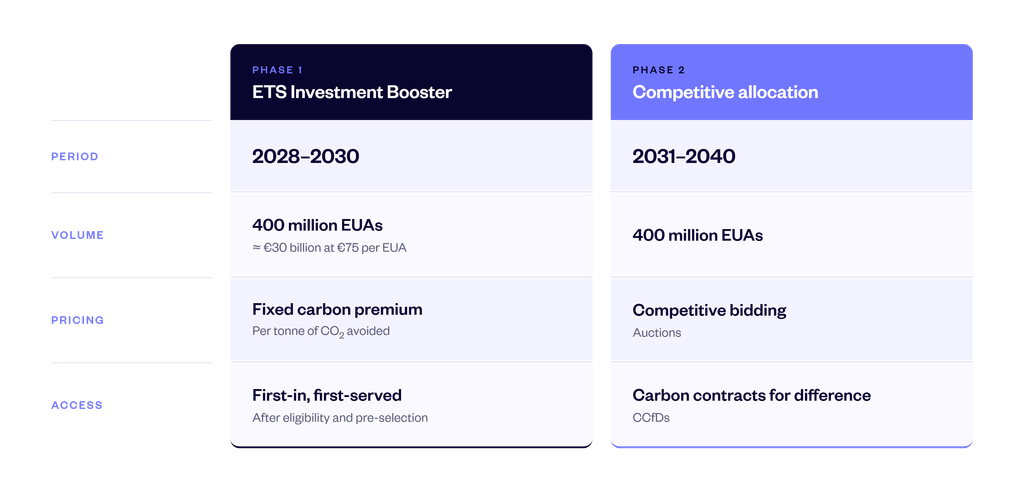
Phase 1 (2028-2030): the ETS Investment Booster
The Investment Booster would reserve 400 million allowances for industrial decarbonisation projects between 2028 and 2030. At a carbon price of around €75/t, this represents €30 billion.
It is designed to move quickly before the fully-fledged IDB becomes operational. The Commission is expected to launch a public consultation in September 2026 to help finalise its design.
Following a light eligibility assessment, projects would receive a predefined carbon premium per tonne of verified emissions avoided, with support allocated on a “first-in, first-served” basis. The stated objective is to provide a relatively simple and predictable support mechanism capable of accelerating investment in technologies that are ready for commercial deployment.
A dedicated 100 million allowances would initially be reserved for lower-income Member States to ensure geographical solidarity, falling to 60 million after the first 18 months.
Phase 2 (2031-2040): Competitive allocation
From 2031 to 2040, the IDB would enter its second phase. It would be backed by a further 400 million earmarked allowances – this time directly from the Union-wide ETS cap under Article 9.
This phase is expected to rely more on competitive mechanisms such as Carbon Contracts for Difference (CCfDs) and carbon-premium auctions, allowing support levels to reflect the funding gaps revealed through competition between projects.
For CCfDs, support could be provided for up to 10 years against a strike price determined through competitive bidding. This is designed to provide longer-term revenue certainty. The detailed eligibility criteria and other conditions for individual award procedures would be set at a later stage, following consultation with stakeholders.
The proposal also allows Phase 2 to begin before 2031 if the Investment Booster is fully used earlier.
Neither Phase 1 nor Phase 2 would add allowances on top of the overall ETS cap. This is important, since creating additional EUAs for the IDB would otherwise increase allowance supply and could weaken the ETS carbon-price signal, affecting both the value of the IDB’s endowment and the economics of industrial decarbonisation.
For the Investment Booster, the key question is therefore not whether it expands the ETS cap. But will redirecting up to 400 million allowances from the existing free-allocation architecture leave enough for the purposes those allowances were originally intended to serve?
Most of the Investment Booster is likely to come from the New Entrants Reserve
Under the proposed Article 10cc, the 400 million allowances for the Investment Booster would first come from any allowances remaining in the existing free-allocation buffer under Article 10a(5b). If fewer than 400 million remain, the shortfall would be taken from the New Entrants Reserve (NER) under Article 10a(7).
In practice, however, the Commission appears to expect little to be left in that buffer.
The buffer was created to reduce the risk that demand for free allocation exceeds the maximum quantity available, triggering the application of the cross-sectoral correction factor (CSCF). And while the ETS proposal increases this buffer from 3% to 4% for the post-2030 period, the Commission’s modelling (Impact Assessment, Part 3) expects the existing 3% buffer to be fully used to meet free-allocation demand between 2028 and 2030.[2]
The legal proposal preserves the possibility that some allowances may remain, since actual free-allocation requirements can still change, but the Commission’s central expectation therefore implies that most, and potentially all, of the Investment Booster’s 400 million allowances would ultimately come from the NER.
How large is the New Entrants Reserve?
The NER entered Phase IV in 2021 with 331.3 million allowances:
- 200 million transferred from the Market Stability Reserve (MSR), and
- around 131.3 million unallocated allowances carried over from Phase III.
It is not, however, a fixed pot. Allowances freed up when installations close or their activity declines flow back into the NER, while new entrants and increases in activity draw allowances from it.
Commission data allows to reconstruct how that balance has evolved. By 30 June 2025, free-allocation adjustments since 2021 had resulted in a net reduction of 171.5 million allowances. As these adjustments are made through the NER, adding this net inflow to its opening stock gives an indicative balance of:
331.3m + 171.5m = 502.8m EUAs
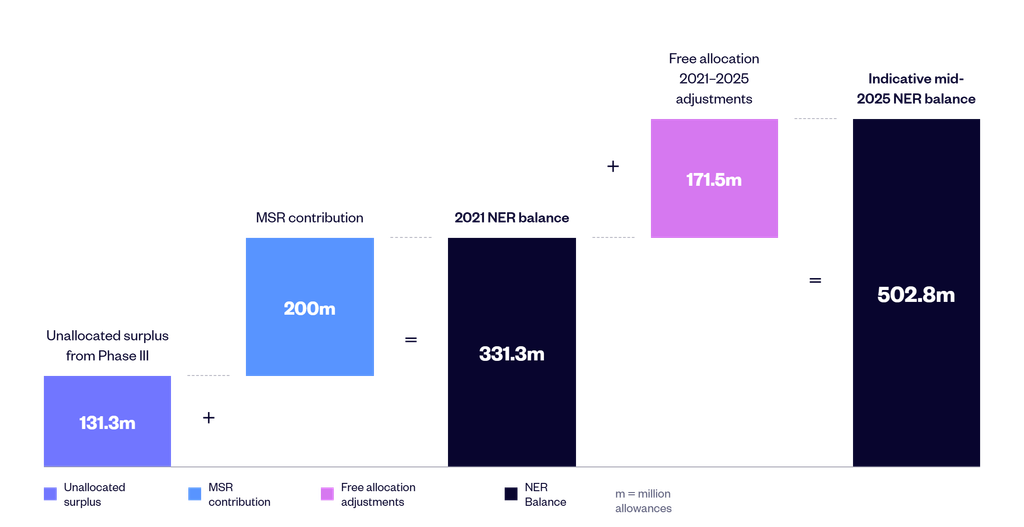
This should be treated as a mid-2025 reconstruction rather than an official live 2026 balance. The Commission reports these free-allocation adjustments in aggregate, meaning that the underlying flows from closures, activity decreases, activity increases and new entrants cannot be fully disaggregated.
Nevertheless, the direction of travel is informative: the available data indicate that the NER has accumulated a substantial stock of allowances during Phase IV – large enough, on this reconstruction, to cover the Investment Booster’s full 400 million allowances before accounting for further changes proposed in the EU ETS review.
The revised EU ETS would also reshape the NER
The Commission is not proposing to draw on the NER without also changing how the reserve operates. The proposal amends Article 10a(7) in three relevant ways.
- Adding new allowances: 50 million allowances linked to the phase-out of free allocation for Carbon Border Adjustment Mechanism (CBAM) sectors would be added to the NER. This represents only a small share of the allowances released through the wider CBAM-related phase-out of free allocation; the remainder would generally be auctioned, subject to the other specific reservations introduced by the proposal.
- Retaining unused allowances: The proposal would remove the current provision under which up to 200 million allowances remaining in the NER at the end of 2030 would be placed in the MSR. Instead, unused allowances would remain available in the NER beyond 2030, helping preserve its capacity to support future new entrants and increases in activity.
- Increasing new-entrant allocations: New entrants would no longer have their free allocation reduced annually by the Linear Reduction Factor (LRF). As Recital 56 explains, this is intended to avoid disadvantaging new installations and potentially discouraging investment in new, lower-carbon production capacity. The change could therefore increase future demand on the NER relative to the current rules.
Estimating the balance after the Investment Booster
Starting from our indicative mid-2025 balance and adding the 50 million allowances explicitly earmarked for the NER gives:
502.8m + 50m = 552.8m EUAs
If the full 400 million allowances for the Investment Booster were then drawn from the NER, this would leave:
552.8m − 400m = 152.8m EUAs
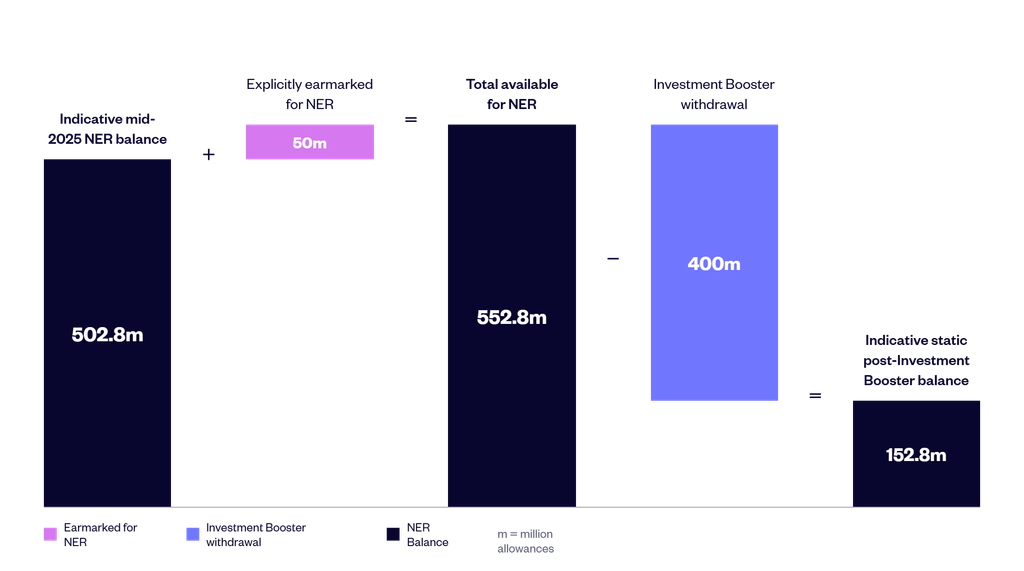
This 152.8 million figure is a static balance-sheet estimate, not a forecast of the NER balance after the Investment Booster. It deliberately excludes any net inflows or outflows between mid-2025 and the eventual draw.
During 2021–2025, those flows were strongly reserve-positive, but there is no reason to assume that trend will continue at the same pace. The Commission has linked substantial downward allocation adjustments during this period to weaker industrial production during the pandemic and energy crisis, while the proposal itself could increase future NER demand by improving the treatment of new entrants.
Could the NER still perform its original function?
The remaining question is whether a substantially smaller NER could still accommodate future new entrants and increases in activity.
Historical experience provides some reassurance. Phase IV has so far been strongly reserve-positive, with downward adjustments to free allocation outweighing additional demand and contributing to the accumulation described above. Historical demand from genuinely new installations has also been relatively modest.
A useful benchmark comes from the Commission’s 2019 analysis of the Phase IV activity-level rules. When stress-testing whether the NER could be exhausted, the Commission modelled new greenfield installations requiring 1, 2 or 5 million allowances per year. It considered 1 million per year broadly consistent with Phase III experience, while describing 5 million per year as an “extreme” scenario.
These annual figures do not translate one-for-one into cumulative NER demand: once a new installation enters the system, it can continue receiving free allocation in subsequent years. The Commission therefore estimated cumulative greenfield demand over Phase IV at approximately 31 million, 63 million and 155 million allowances, respectively.
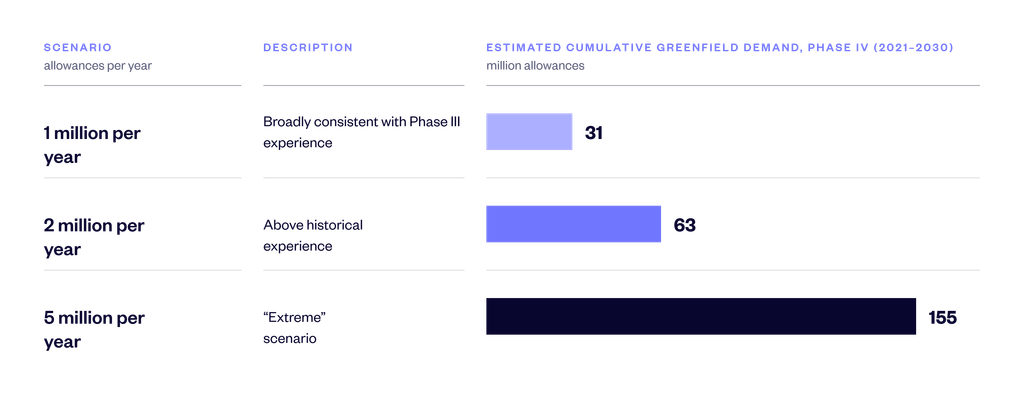
Even under historically normal greenfield entry, activity increases at existing installations would have needed to become substantially larger than previously observed for the reserve to be exhausted.
This provides a useful, although imperfect, benchmark for our ~153 million static post-Investment-Booster balance. That amount is roughly equivalent to the Commission’s previous estimate of the entire cumulative greenfield requirement under its deliberately extreme 5 million allowances-per-year scenario.
Moreover, the NER is continuously replenished when installations close or activity falls – a mechanism that has, on balance, increased the reserve substantially during Phase IV.
Why historical demand cannot predict future NER needs
There are good reasons not to take the previous comparison too far.
The post-2030 period will not simply reproduce historical conditions. EU industrial policy is explicitly seeking to stimulate investment in new low-carbon production capacity; if successful, greenfield demand on the NER could rise materially.
The proposal would also remove the LRF adjustment from new-entrant allocations, increasing the amount of free allocation available to qualifying new installations relative to current rules. And activity increases at existing installations would continue to compete for the same reserve.
Nevertheless, the proposed 400 million allowance draw appears defensible on the evidence currently available. A static residual of around 153 million allowances is substantial relative to historical new-entrant demand and even compares favourably with the Commission’s previous extreme greenfield stress test.
The precise margin, however, will depend on how European industrial investment evolves – and on the future inflows and outflows of a reserve that is inherently dynamic.
A sensible balance between immediate investment needs and future demand
The Commission’s proposed ETS Investment Booster does not rely on creating 400 million additional allowances. Instead, it would repurpose allowances already available within the ETS free-allocation architecture. Although the legislation prioritises any unused free-allocation buffer, the Commission’s own modelling suggests that this buffer is likely to be fully used.
The New Entrants Reserve could therefore provide most, if not all, of the Investment Booster’s 400 million allowances. This is a substantial withdrawal, but the available evidence suggests that the NER is in a relatively strong position to absorb such a draw. The Commission proposal would also reinforce the reserve with 50 million allowances and allow unused NER allowances to remain available beyond 2030.
Furthermore, earmarking a fixed volume of allowances for the Investment Booster is a welcome design choice. By establishing an upstream allowance reserve rather than relying on ex-post transfers of auction revenues, the Commission provides greater predictability over the resources available to support industrial decarbonisation. The eventual monetary value will still depend on the EUA price, but the quantity of allowances underpinning the instrument is known in advance.
The remaining transparency gap
The bigger weakness is transparency. There is currently no straightforward public balance sheet showing how many allowances enter and leave the NER each year, for what purpose, and how many remain available.
That was already a limitation when the NER served primarily as a technical mechanism for free allocation. It becomes harder to justify once potentially hundreds of millions of allowances from the reserve are redirected towards a major EU industrial-financing instrument.
As the NER takes on this additional role, the Commission should publish a regular account of its opening stock, inflows, allocations and other withdrawals, and closing balance. This would allow policymakers and market participants to assess whether financing the Investment Booster remains compatible with supporting new industrial capacity – and whether that balance changes as Europe's industrial transition accelerates.
Greater visibility over the resources being mobilised at EU level could also help Member States assess where their own ETS revenues can provide complementary support, including through additional contributions to the Industrial Decarbonisation Bank.
Addendum: September 2026
The Commission’s July 2026 Decision on the cross-sectoral correction factor (CSCF) establishes that 289.2 million of the 368.4 million allowances in the existing 3% free-allocation buffer would be used over 2021-2030, leaving around 79.2 million allowances.
Crucially, in a separate proposal on the heat and fuel (“fallback”) benchmarks, the Commission has suggested using the entirety of this remaining amount to increase free allocation for installations covered by those benchmarks between 2026 and 2030. If that proposal is adopted as drafted, no allowances from the existing free-allocation buffer would remain available for the Investment Booster. The Booster’s entire 400 million allowance endowment would therefore need to come from the NER.
This does not affect the quantitative analysis above, which already assumed the full 400 million allowances were drawn from the NER, leaving an indicative static balance of around 152.8 million allowances.
[1] The New Entrants Reserve (NER) is not to be confused with NER300, which was an EU funding programme financed through the sale of 300 million allowances from the Phase III New Entrants Reserve to support carbon capture and storage and innovative renewable energy demonstration projects. NER300 was subsequently succeeded by the Innovation Fund.
[2] Note: the Commission analysis relied on the newly adopted Implementing Regulation (EU) 2026/1412, which sets out the revised benchmark values for free allocation of emission allowances from 2026 to 2030.