The Commission's 2026 proposal to revise the EU Emissions Trading System (ETS) introduces a new mechanism: the "Invest in EU Decarbonisation Plans". From 2031, many industrial installations could have to invest in decarbonisation to retain their full free allocation. This post unpacks the mechanism, explaining what the plan requires, how free allocation would be distributed, what counts as eligible investment, and what it means for industrial carbon management.
How the Decarbonisation Plans would change free allocation.
The European Commission’s EU ETS review proposal introduces a significant new condition for industrial installations receiving free allocation. From 2031, operators would need to prepare “Invest in EU Decarbonisation Plans” (Decarbonisation Plans for short) setting out how they intend to invest in reducing emissions from their installations.
Free allocation is currently the EU ETS’ main tool to protect European industry against carbon leakage. The volume of free allowances that each installation receives is mainly determined by its historical activity level and the applicable ETS benchmark(s). The European Commission now wants to turn free allowance conditionalities into an investment engine.
While the current system already includes some conditionality, the Commission’s proposal would go significantly further: it would link continued access to the full amount of free allocations to actual decarbonisation investment. Decarbonisation Plans must include an investment commitment corresponding to at least 100% of the economic value of the free allowances allocated to the installation.
Decarbonisation Plans would also need to be consistent with the EU’s 2050 climate-neutrality objective and include intermediate targets for 2035. Operators would submit their first plans alongside their free allocation data by 30 September 2029, and every five years afterwards1. New entrants after that date would submit their plans with their application for free allocation.
This creates an important new link between free allocation and industrial investment. It also raises several questions: How much will installations need to invest? When will they receive their allowances? What will they need to demonstrate to keep the full allocation?
What does an “Invest in EU Decarbonisation Plan” require?
For incumbent installations, the first plans would accompany the national implementation measures (NIMs) data used to determine free allocation. The plan and its contents would be subject to verification under the existing Article 15 framework of the EU ETS Directive and made publicly available.
Decarbonisation Plans would need to set out the investments planned to decarbonise each installation. To retain their free allocation, operators would have to invest at least 100% of the economic value of their free allocation in decarbonisation activities in the EU.
What that obligation will amount to in euros is not yet known. Article 10a(3e) leaves the methodology for determining the economic value of free allowances to a future delegated act. The methodology will matter, because the value of a given volume of free allocation, and therefore the investment obligation attached to it, depends on how the EUA price is determined for this purpose.
The Commission intends this conditionality to turn free allocation into a stronger incentive for investment in low- and zero-carbon production. Figure 1 sets out the key dates in this first five-year cycle.
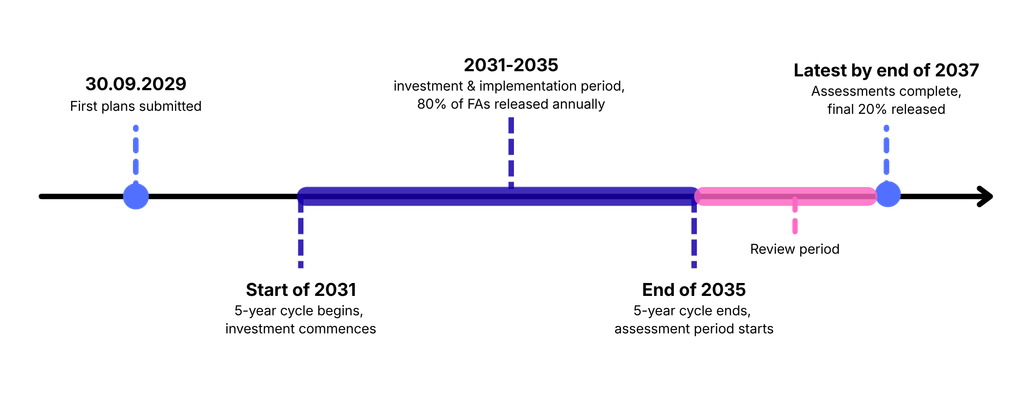
Figure 1. Key dates in the first five-year cycle for an Invest in EU Decarbonisation Plan, from initial submission through to the final assessment of the withheld allocation.
Decarbonisation Plans would operate on a five-year cycle, starting from 2031. Over each period, operators would need to implement the planned investments and achieve “significant emissions reductions” at installation level. A new plan would then be required for the next five-year free allocation period. During each five-year cycle, free allocation distribution would follow an 80/20 structure, with part of the allocation withheld until the relevant conditions have been met.
How will the 80/20 conditionality work?
From 2031, free allocation would be distributed differently. Operators with a verified and approved Decarbonisation Plan would receive 80% of their calculated free allocation for the relevant five-year period in annual tranches. The remaining 20% would be withheld until the competent authority confirms that all the conditions for its release have been met, no later than two years after the end of the five-year period.2
The release conditions for the remaining 20% are:
- The decarbonisation investments set out in the plan have been implemented in the EU.
- The amount invested is at least equal to 100% of the economic value of the free allocation for that period.
- The installation's verified annual emissions reports demonstrate significant emissions reductions at installation level within that same five-year period.
Figure 2 presents the annual 80/20 split, how the withheld allocation accumulates over the five-year period, and the conditions that determine whether it is ultimately released
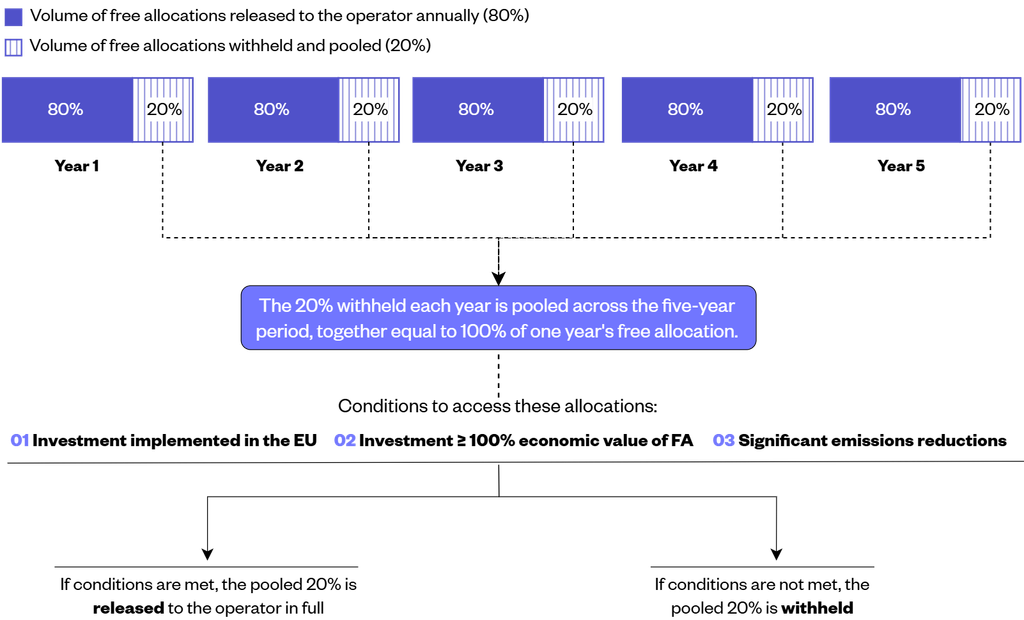
Figure 2. Disbursement of free allocation (FA) under an Invest in EU Decarbonisation Plan: the annual 80/20 split, the pooled 20% over the five-year period, and the conditions governing its release.
Importantly, the mechanism does not provide operators with cash to finance their investments. The benefit comes as free allowances, not as a grant.
Operators would continue to receive 80% of the free allowances each year during the five-year period. The remaining 20% would accumulate and be distributed only if the planned investments and the resulting emissions reductions are achieved by the end of that period. Allowances withheld due to failure to meet the conditions are transferred to the general free allocation pool in the subsequent five-year period. Operators would therefore need to finance the investments before knowing whether the withheld allocation will ultimately be released.
This schedule increases operators' exposure to carbon costs compared with receiving the full allocation upfront. As a result, this structure creates both an incentive to decarbonise during the implementation period and a completion incentive to deliver the investments and emissions reductions set out in the plan. This mechanism may, however, require additional financing from third entities, especially during the transition period. Financial institutions may play an important role here.
What counts as a decarbonisation investment?
The scope of eligible investments under the Decarbonisation Plans has yet to be determined. The proposal does not prescribe specific eligible technologies. Instead, investments would need to be consistent with the EU’s 2050 climate-neutrality target, while the plans would include intermediate targets for 2035 and consider the role of circularity. Carbon offset credits cannot be used to meet the requirement.
The proposal does impose a geographic requirement: the decarbonisation investments must be implemented in the EU. Importantly, qualifying investment would not be limited to CAPEX: the proposal also allows OPEX to count. However, the Commission will still need to define in a future delegated act which specific costs qualify as eligible investments. Eligibility is a central issue for industrial carbon management.
There is an open question about the geographical scope of the plans. While decarbonisation needs to happen on the installation level, using CCS often requires cross-border cooperation and investment. The question of eligibility of e.g. CO2 transport infrastructure costs from an EU Member State to an EEA state providing storage emerges and has not yet been definitively settled.
What this means for industrial carbon management projects
The upcoming delegated act will be key for industrial carbon management projects. The proposal does not yet establish, for example, whether costs such as operating a CO2 capture facility, CO2 transport tariffs, or storage fees could count towards an installation's investment obligation. The delegated act will therefore determine how the conditionality applies to carbon capture and storage (CCS) projects in practice.
How much eligible expenditure an operator will ultimately need to demonstrate also remains uncertain. The Commission's Impact Assessment estimates that conditional free allocation could generate €50–90 billion of investment over 2031–2040. The Commission must still establish the methodology for determining the economic value of the free allowances against which the 100% investment requirement will be assessed, which will have significant consequences for industrial investment.
Why pooling could matter for industrial carbon management
Industrial installations do not all have equal access to the infrastructure needed to decarbonise. This matters for industrial carbon management, where access to CO2 transport and storage infrastructure can determine whether an individual capture project is viable.
To address such differences, the proposal would allow operators to fulfil their investment obligations jointly through a “joint decarbonisation investment agreement”. The Commission explicitly identifies uneven access to CO2 transport infrastructure, alongside electricity grids and green hydrogen, as one of the reasons for introducing pooling.
This agreement would have to specify which installations take part in the joint undertaking and cover at least the relevant five-year period (as opposed to ad hoc pooling decisions halfway through the period). The total investment would need to correspond to at least 100% of the economic value of the free allocation granted to all participating installations in the pool during the relevant five-year period. The proposal would also expressly allow pools to include installations in different Member States.
The precise scope of this flexibility is not entirely clear from the proposal. The legal text does not require participating installations to belong to the same industrial cluster or depend on the same infrastructure. Taken literally, it could allow geographically dispersed installations to combine their obligations and concentrate investment at one or more installations in the pool.
The proposal's rationale, however, points towards using pooling to overcome unequal access to decarbonisation solutions and enabling infrastructure. It expressly envisages one or more operators investing on behalf of other members of the pool, with a higher level of emissions reduction required from the investing installation or installations.
What pooling could mean in practice
For industrial carbon management, the mechanism could be particularly relevant in clusters and cross-border networks where several emitters depend on common infrastructure. A cement plant, a lime producer and a waste-to-energy installation might each face separate investment obligations, while their decarbonisation depends on shared CO2 conditioning, transport or storage infrastructure. A joint agreement could potentially allow the participating installations to combine their investment obligations and direct investment towards the infrastructure or installations best placed to deliver emissions reductions.
The rationale behind the pooling mechanism is to give operators flexibility where access to decarbonisation technologies and enabling infrastructure is uneven across installations and regions. Figure 3 illustrates how installations could pool their individual investment obligations.
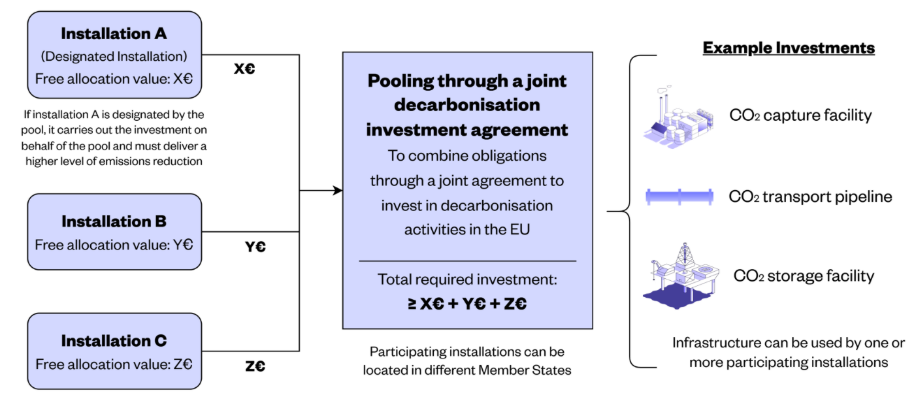
Figure 3. Pooling through a joint decarbonisation investment agreement. Participating installations combine their investment obligations.
CCS projects often depend on infrastructure that sits beyond the boundary of an individual ETS installation. Pooling could therefore help the free-allocation conditionality better reflect how industrial decarbonisation projects are developed in practice and help unlock the necessary financing for CO2 hubs. Whether expenditure on shared CO2 infrastructure itself can count towards the pooled investment obligation is not yet clear. The Commission must still establish the list of eligible decarbonisation investment costs through a delegated act.
Some important details also remain unresolved. The Commission must still define the conditions for forming a pool, including arrangements involving installations in different Member States, and how liability for meeting the investment requirements is distributed between participating operators. The proposal also indicates that installations making the investment on behalf of the pool should be required to achieve a higher level of emissions reduction but does not yet specify how that higher threshold would be determined.
Exemptions and safeguards
The proposal provides several exemptions and derogations from the new conditionality.
Installations with projects selected for support under either the Industrial Decarbonisation Bank or the Innovation Fund would receive a derogation from preparing a Decarbonisation Plan, provided the supported project is being implemented during the relevant five-year period.
The first 80% of free allocation would be handed out following the decision to award support to the project. The remaining 20% would be released once the relevant project milestone is reached (disbursement of Innovation Fund support or start of physical construction for Industrial Decarbonisation Bank/Investment Booster projects) and eligible costs equivalent to at least 100% of the economic value of free allocation have been verified.
A broader exemption would apply to the top 10% most efficient installations (following the benchmark values) in each sector or subsector, and for qualifying zero- or low-carbon installations, and certain small installations remaining voluntarily in the ETS. These installations would be eligible for their full free allocation without preparing a Decarbonisation Plan. The criteria for qualifying as a zero- or low-carbon installation are not yet fixed and would be defined in a future delegated act.
The proposal also includes a safeguard against operators meeting the new requirements through shifting production outside the EU. If an installation relocates or transfers all or part of the relevant production capacity or associated economic activity outside of the Union during the relevant allocation period, the Member State would require repayment of the free allowances received. If they are not repaid, an equivalent amount would be deducted from future free allocation. This clawback mechanism aims to provide another layer of protection against carbon leakage.
What happens next?
The European Parliament and the Council are now reviewing the Commission’s proposal. It establishes the broad architecture of the new conditionality, but it does not yet settle how the system would work in all its practical details. The provisions may still change during negotiations between the European Parliament and the Council, while several key elements are expressly left to subsequent delegated and implementing acts.
Remaining open questions
Several of the rules that will determine the economics and feasibility of the mechanism remain open.
The Commission would still need to define:
- which costs and types of infrastructure qualify as decarbonisation investment
- how the economic value of free allocation is calculated, and what constitutes “significant emissions reductions”
- the detailed conditions for pooling and liability between participating operators
- the criteria for certain exemptions
- the detailed content and format of the plans, which would be specified later through implementing acts, which also govern eligibility
- the exact conditions surrounding eligibility of infrastructure crossing from an EU plant into an EEA storage site
- what happens to FA distribution after full early decarbonisation
The definition of “significant emissions reductions” could be particularly important for industrial decarbonisation projects with long development and construction timelines. A project may involve substantial investment during one five-year period while delivering most of its emissions reductions only towards the end of, or beyond, that period. How this requirement is ultimately defined and applied will therefore be important for capital-intensive technologies and projects with long lead times, including CCS.
The case of FA distribution after decarbonisation is not clear from the proposal. Should an installation have completely decarbonised, in line with the plan, by 2031, it is unclear whether or not FA allocation continues as previously. If this were the case, the incentive to decarbonise would be stronger.
Key steps before 2031
The implementation timeline for these rules will depend first on the negotiations over the revision of the ETS Directive, and then on the adoption of the delegated and implementing acts needed to operationalise the new system.
A final agreement on the ETS revision is foreseen in early 2027, although past revisions have typically required longer negotiation phases. For operators and project developers planning investments for the 2030s, these decisions will matter well before the conditionality begins to apply in 2031. Under the Commission’s proposal, the first plans for incumbent installations would already be submitted in 2029.
For industrial carbon management in particular, the treatment of eligible costs, long project lead times, and shared infrastructure will be critical. The European Commission is committed to unlocking decarbonisation investment. The proposal creates the possibility for free allocation to become a substantial industrial investment lever, but the delegated and implementing acts will determine how usable that lever is for CCS projects.