As CO2 networks expand across national borders, harmonised standards are needed to ensure safety, interoperability, and system integrity; and ultimately to enable large-scale deployment of carbon capture and storage across Europe. Two bodies lead this work at the international and European level: ISO/TC 265 and CEN/TC 474, with which Carbon Management Europe engages as a liaison observer. This post recaps recent developments across those standardisation bodies and sets out the priority areas where harmonised standards can help carbon management infrastructure scale.
Carbon capture and storage (CCS) operates across the full value chain, and often across national borders. In fact, as planned geological storage capacity is unevenly distributed across Europe, many projects rely, and will continue to rely, on coordinated cross-border transport and shared infrastructure. In this context, a harmonised, standardised approach is needed to ensure safety, system integrity, interoperability, and trust across the CO2 value chain. In short, standardisation is essential to scale CCS across Europe.
Two bodies lead this work: ISO/TC 265, the international standards technical committee for CCS, and CEN/TC 474, its European counterpart. The European Commission’s public consultation on CO2 markets and infrastructure also included a section specifically on “CO2 stream quality standardisation and quality management”. These efforts aim to identify and address where standardisation is needed to support deployment, manage risk, reduce uncertainty and accordingly enable investment.
Carbon Management Europe engages directly with these standardisation technical committees as a liaison observer and is supporting the development of the upcoming European CO2 market and infrastructure regulatory framework. This post recapitulates the main takeaways from these engagements and outlines the priority areas where harmonised standards can allow carbon management infrastructure to scale in Europe.
Why do CO2 streams need harmonised quality standards?
An overview of CO2 composition and quality
The purity level of CO2 streams is heavily shaped by the emitter profile and the capture technology used. CO2 separated from pressurised process streams, such as natural gas processing or hydrogen production, is typically relatively pure. By contrast, CO2 captured from flue gases (post-combustion) in cement, steel, or waste-to-energy facilities contains a broader range of impurities that must be managed before transport and storage.
Anthropogenic CO2 streams may contain sulphur oxides (SOx), nitrogen oxides (NOx), oxygen (O2), hydrogen sulphide (H2S), trace metals, particulates, and residual moisture. These impurities can promote corrosion of transport and storage infrastructure, alter CO2 phase behaviour, and lead to solid deposition. Long-term infrastructure integrity is the central concern here. Even a small corrosion rate can become a significant risk given enough time, and the physics of how multiple impurities interact is not yet fully understood. The diagram below reflects the simplified version of current understanding of these reaction pathways.
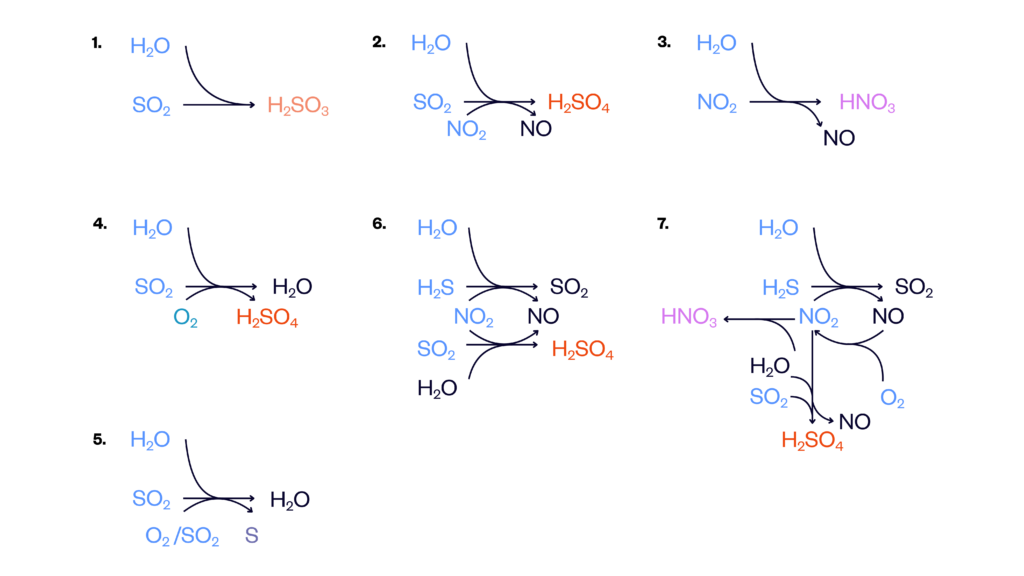
Figure 1. Possible chemical reactions between a range of impurities (source)
Article 12(1) of the EU CCS Directive requires that CO2 streams injected into geological storage consist “overwhelmingly of carbon dioxide”, while allowing incidental associated substances as long as they don’t compromise transport or storage integrity and do not pose risks to environmental or public health. Yet, there is currently no unified CO2 composition standard.
Therefore, stakeholders broadly agree that EU-wide minimum quality standards are needed to avoid market fragmentation, ensure cross-border interoperability, and provide clarity for investors and operators.
CEN/TC 474 is drafting a new European standard, prEN 18397, Properties of Carbon Dioxide Fluxes in Carbon Steel Pipelines. It will set requirements for CO2 stream composition and explain how CO2 affects pipeline design and operation, for both gaseous and dense-phase transport. Follow-up standards will extend this work to tank transport at low, medium, and elevated pressure.
A risk-based, fit-for-purpose approach
From a system perspective, CO2 purity requirements should be defined to be cost-effective while still ensuring safe and reliable operation of the transport and storage system.
Under this approach, harmonised baseline limits must be set for critical impurities that materially affect safety, asset integrity, or operability (e.g. corrosion, hydrate formation, phase instability, toxicity, or metering uncertainty). Stricter thresholds should apply where required by the most sensitive element of the transport–storage chain. Examples include dense-phase pipelines, liquefaction and shipping interfaces, and specific storage reservoir constraints.
In some cases, alternative measures can achieve the same safety and integrity outcomes. These include enhanced monitoring and verification, real-time sensing, corrosion-resistant materials, dehydration at specific nodes, or operational controls. Where that’s possible, controlled variances and tiered specifications can avoid unnecessary over-purification.
This approach offers several benefits:
- Links the purification effort to actual downstream needs
- Reduces total system cost and energy penalty
- Supports interoperable networks, including blending CO2 from multiple sources
- Creates room for innovation in lower-cost capture technologies, without compromising safety or environmental integrity
Ongoing research on CO2 quality standards
This work is supplemented by active research:
- Stand4Purity (November 2025 – October 2026) is developing European pre-standardisation research on minimum CO2 purity requirements.
- CO2RE (July 2026 - July 2028) project, run by Gasunie, EBN, and DNV, is studying how impurities react under realistic CO2 transport conditions to support safer and more economical pipeline networks.
- IMPACT-EUCO2 (June 2026 – May 2029), a Horizon Europe project coordinated by IFE (Norway), studies impurity impacts on the CO2 transport systems.
- SPECS (May 2026 – October 2029), a new Horizon Europe project coordinated by IFP Energies nouvelles, examines the impact of impurities on the storage complex itself.
- CO2 SpecChain (Q3 2026 – Q3 2027), a newer DNV-led joint industry project, is set to launch in Q3 2026 to build a unified framework for managing CO2 composition across the whole value chain.
Continued research, laboratory capacity and industry-wide data sharing are essential to refine specifications over time. Early projects may need to adopt conservative impurity limits, gradually adjusting them as operational experience and R&D provide a better understanding of impurity interactions and material durability.
Key challenges span technical, economic, and governance dimensions:
- defining realistic limits for equipment integrity;
- improving modelling capabilities for mixed CO2 streams;
- managing quality in clustered networks;
- balancing cost allocation along the value chain;
- and ensuring transparency in the emerging CO2 market.
In parallel, ISO/TC 265 now identifies the development of a Technical Report on Direct Air Capture (DAC) as a high priority.
Harmonising and standardising CO2 transport
Another important area to standardise is CO2 transport, but different transport modes require different approaches. While pipelines remain central to large-scale CCS deployment, non-pipeline transport modes (ship, truck, and rail) also play an important role, particularly in early phases and for smaller or more remote emitters.
These transport modes operate differently. Pipelines operate continuously and rely on a combination of online and offline monitoring. By contrast, non-pipeline transport is batch-based and depends primarily on offline analysis of individual cargos. These differences lead to distinct specification, monitoring, and verification needs, particularly for impurities that behave differently under compression versus liquefaction.
A workable approach for harmonised CO2 transport
In practice, CO2 quality is measured and controlled at operational handover points along the value chain, such as capture installations, pipeline entry and exit points, terminals, compression stations, and injection facilities, rather than “at the border”. ISO has also identified interface issues at these same handover points, including buffer storage, as a potential area for future standardisation.
For cross-border transport, border-check concepts are therefore impractical, particularly for pipelines, and risk creating artificial bottlenecks and enforcement gaps. A more workable approach is operator-led cross-border cooperation, supported by binding cooperation obligations, transparent cost-sharing rules, and light-touch coordination between authorities for oversight and dispute resolution.
In this context, route-specific CO2 specifications agreed between interconnected operators (within EU-level baseline safety and integrity requirements) can provide the flexibility needed for early network build-out while ensuring uninterrupted flows and interoperability across transport modes.
Carbon Management Europe's response to the public consultation sets out what that baseline should look like: an EU-wide minimum CO2 stream quality standard, limited to well-understood impurities, that safeguards infrastructure integrity, protects health and the environment, and reduces avoidable costs from outages or damage.
Pipeline materials and safety
For metallic pipelines, a key safety consideration is ductile fracture, the failure mode that determines safe wall thickness and diameter limits. ISO is planning to develop a new standard (PWI 27939) to standardise its numerical simulation.
Current pipeline standards largely focus on metallic materials. Non-metallic, hybrid, and composite pipelines could improve flexibility and cost-effectiveness in certain applications. These materials may be particularly relevant for connecting smaller or biogenic CO2 sources to larger networks.
At the same time, risks such as delamination and long-term material performance in corrosive CO2 environments require careful assessment. Clear guidance on material selection and qualification is therefore a growing priority.
A technical report (prCEN/TR 18404) titled “Use of polymer and composite materials in pipeline transportation of CO2 streams in gaseous and dense phase” is under development at CEN/TC 474. The report assesses the suitability of thermoset (rigid) and thermoplastic (flexible) polymer and composite pipes, polymer and composite liners in metallic pipelines (pipe-in-pipe systems), and metal-reinforced polymer pipes for transporting CO2.
CO2 measurement, monitoring, and accounting
Accurate measurement and monitoring of CO2 flows underpin billing, emissions reporting, and liability allocation.
CEN/TC 474 is developing methodologies for both pipeline and non-pipeline transport, while a new ISO report (ISO TR 27937) and a CEN standard (preEN 18329) under development aim to guide sampling, metering, measurement and quantification.
Contributors to the technical standardisation committees also emphasise the importance of open-access digital tools and interoperable data standards to enable transparent CO2 quality tracking and CO2 accounting along the value chain and across borders.
Harmonisation of CO2 accounting across existing standards and EU legislative frameworks is also under discussion at CEN level.
Storage risk management and cross-license cooperation
While the EU regulatory framework is stringent, gaps remain in monitoring and coordination across different subsurface licences, particularly regarding pressure management, legacy wells, and third-party verification.
The second edition of ISO 27914 (Carbon dioxide capture, transportation and storage — Geological storage) was published in March 2026. CEN/TC 474 is comparing existing standards, including ISO 27914, with EU legislation such as the CCS Directive to identify remaining gaps and inconsistencies, supporting consistent cross-border storage operations and long-term liability management. In the future, these remaining gaps could also be addressed through guidance documents under the CCS Directive.
At ISO level, new work items are also under development on the staged transition of oil-producing fields to geological CO2 storage, legacy well assessment, and pressure interference and management.
Ex-situ CO2 storage
A related but distinct pathway, ex-situ CO2 storage, refers to the storage of CO2 above ground rather than underground.
Standardisation efforts are still at an early stage. Depending on the storage route, they require traceable and quality-controlled CO2 inputs. Unified, route-specific specifications can support innovation and scaling while maintaining environmental and safety integrity, especially as pathways diversify. ISO’s draft specification (TS 27933) on “Mineral carbonation — Quantification of CO2 captured through mineral carbonation technology” is currently under development.
Digital tools and traceability
Data management underpins every step of the carbon management value chain. A new ISO report (TR 27936) on “Traceability of Carbon data in CCS Chain Based on Blockchain” will explore the use of blockchain for CO2 traceability, ensuring reliable custody transfer, carbon accounting, and certification across borders. Integrating digital traceability standards into CEN and ISO work will strengthen market confidence and transparency.
Cross-cutting terms and definitions
Although often overlooked, standardisation efforts are not limited to technical specifications. Consistent terminology is essential for tracking deployment and enabling meaningful comparison across projects and jurisdictions.
Harmonised definitions for CO2 capture, transport, storage, monitoring, risk, and stakeholder engagement provide a common language for regulators, operators, and the public, and are a foundational element of effective standardisation.
The second edition of ISO 27917 (Vocabulary – Cross-cutting terms) is currently under approval process and is being developed as a joint CEN–ISO project under the Vienna Agreement[1].
From technical alignment to strategic enabler
As Europe moves from pilot projects to large-scale deployment, standardisation is becoming a strategic enabler rather than a purely technical exercise. Well-designed standards help translate policy objectives into operable systems, reduce uncertainty for investors, and ensure that CO2 networks can expand safely and cost-effectively across borders.
Carbon Management Europe engages as a liaison observer with European and international standardisation activities, ensuring that emerging standards reflect operational reality, support interoperability, and stay aligned with Europe’s climate and industrial objectives.
Carbon Management Europe encourages stakeholders across the carbon management value chain to:
- Engage in standardisation discussions and public consultations to ensure that emerging standards remain fit for purpose and grounded in operational reality;
- Share data and lessons learned, particularly on CO2 quality, impurities, materials performance, and monitoring, to support evidence-based standards; and
- Collaborate across sectors and borders to build interoperable, future-proof CO2 networks that can scale with Europe’s climate ambition.
By working together, Europe can develop a coherent, cost-effective, and trusted framework for carbon management, turning standardisation into a catalyst for deployment rather than a barrier to progress.
The full list of standards under development by CEN/TC 474 and ISO/TC 265 is available in the hyperlinks.
Footnotes
[1] The Vienna Agreement is an official cooperation framework between ISO and CEN, the European Committee for Standardisation. Its main purpose is to avoid duplication of work and ensure alignment between international (ISO) and European (EN) standards, so that a single standard can serve both globally and within Europe.