With the forthcoming CO2 market and infrastructure regulatory framework proposal, the European Union (EU) intends to build an internal market for CO2. That ambition depends on a legal reality often overlooked: whether offshore CO2 storage is permitted can vary from one sea basin to the next.
Each of Europe's four basins is governed by its own Regional Sea Convention, and each regulates activities such as carbon capture and storage (CCS) somewhat differently. This blog maps those four legal regimes and explains where CCS stands in each, aiming to identify existing and potential obstacles for an EU internal market for CO2.
Europe’s sea basins and the law on offshore CO2 storage
Europe is bordered by four major sea basins: the Mediterranean Sea, the North Sea, the Black Sea and the Baltic Sea. Each borders different countries within and outside the European continent. As a result, their governance is not only a matter of national law, but also European and international law.
International law covers more than international treaties such as the London Protocol. It also includes regional conventions: specialised treaties with a limited geographic scope, such as a single sea basin. These conventions reflect a shared willingness among States to cooperate to prevent pollution and protect the maritime environment. They set out rules and guidance on whether activities, such as CCS, can be carried out and if so, under what conditions.
The Commission’s forthcoming proposal on the CO2 market and infrastructure regulatory framework makes these legal regimes particularly important. Understanding them, and the extent to which they enable CCS, is essential to identify existing and potential obstacles to the European Commission’s aim of creating an internal market for CO2.
Regional Sea Conventions follow different regulatory models
Reverse-list versus black-/grey lists approaches
Regional Sea Conventions generally aim to protect the marine environment by limiting pollution and dumping of waste and other matters at sea. Most do this through one of these two approaches:
- The reverse-list approach bans all forms of dumping by default. The Annexes usually list the exceptions and the conditions attached to them.
- The black-/grey-list approach uses colours to indicate what is permissible: black means dumping is prohibited; grey indicates dumping is allowed, usually under a special permit. Matter/wastes not included in either list are generally subject to a general permit.
The reverse list approach can become anachronistic over time. Adapting it to new activities typically involves a formal amendment of the text – a long and often onerous process.
The black-/grey- list approach, by contrast, tends to make legal instruments more flexible. This is because it can accommodate activities and technologies not foreseen at the time of the treaty drafting, some of which date back to the early 1970s.
Mapping how each convention treats CO2 storage
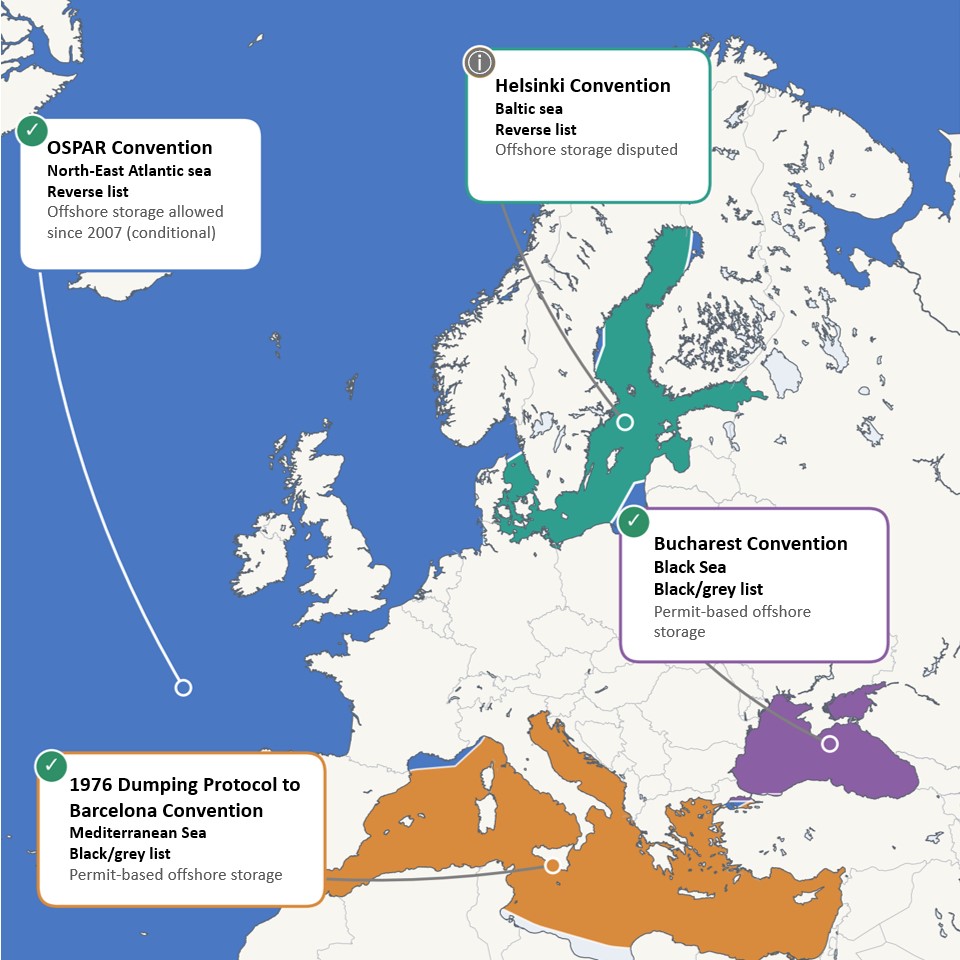
The approach a convention adopts affects the permissibility of CCS. The map below illustrates the different European basins, the convention regulating them, their regulatory approach and how it affects CO2 storage in practice.
OSPAR Convention: a reverse-list turned into a CCS-ready framework
The OSPAR Convention covers the North-East Atlantic, including the North Sea. It has sixteen Contracting Parties located in Europe, plus the European Union itself. It resulted from a 1992 merger of two earlier instruments: the Oslo Convention, which focused on preventing dumping from ships and aircraft, and the Paris Convention, which focused on preventing pollution of the marine environment and from land-based sources.
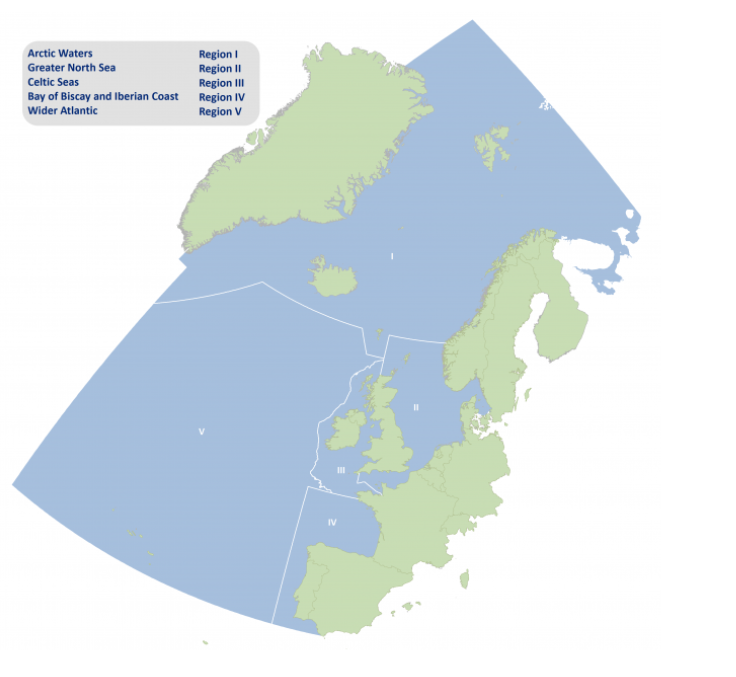
Figure 1: the OSPAR Convention covers the whole of the North East Atlantic and is divided into five sub-areas as follows: Arctic waters, Greater North Sea, Celtic Seas; Bay of Biscay and Iberian Coast; and Wider Atlantic.
Adopting a reverse-list approach, it long omitted CO2 from the list of substances permitted for disposal at sea. That changed with the inclusion of CO2 streams in the reverse list of the London Protocol in 2006. Developments at the international level created the right momentum which led to amendments of the OSPAR Convention in 2007. These consisted of two main changes.
First, carbon dioxide streams from capture processes for geological storage were included under Annex II. This means that today geological CO2 storage is allowed following four conditions. The table below shows how the first three broadly mirror those of the London Protocol, with some terminology differences. The fourth is an OSPAR addition.
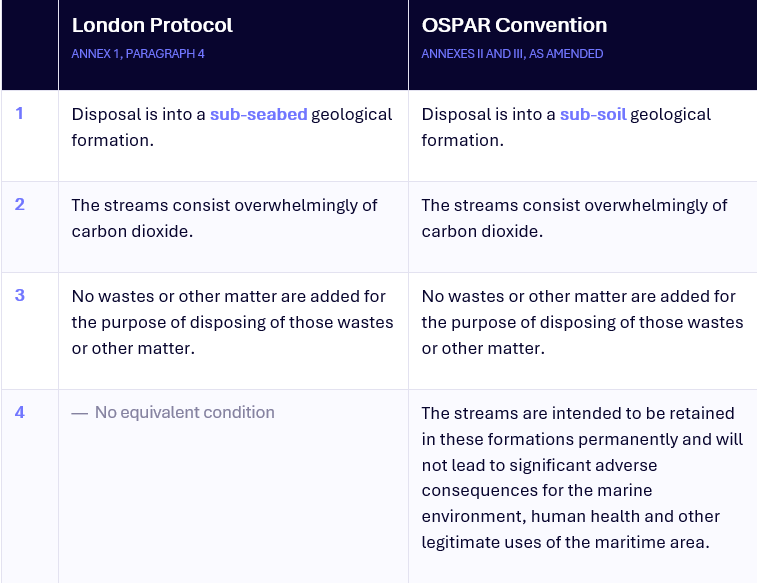
Table 1 compares the vocabulary used in London Protocol and OSPAR Convention when listing the conditions for CO2 streams to be exempted from the dumping prohibition.
Second, Annex III was modified to exempt CO2 from the prohibition of dumping from offshore installations, following the same requirements of Annex II. The exemption was accompanied by an authorisation requirement from a competent authority.
These 2007 amendments created an enabling legal framework for CCS in the North Sea. In addition to its favourable geology, the region has also been to also benefit from an international regulatory environment allowing and regulating CCS within the basin.
Barcelona Convention: permissible today, but what about tomorrow?
The Barcelona Convention, concluded by 21 States and the European Union, protects the Mediterranean Sea. It is complemented by seven protocols. The most relevant for CCS activities is the 1976 Dumping Protocol, which follows a black/grey-list approach.
CO2 is not explicitly listed anywhere, meaning it can be discarded following a general permit. That permit, however, is not automatic: its issuance is constrained by factors set out in Annex III. Additionally, a special permit could also be triggered if the activity is deemed to endanger human life, or the marine environment or interfere with navigation (Annex II).
These rules do not necessarily reflect a fixed picture, considering that the Dumping Protocol has been amended in 1995. Beyond a name change, the amendment marked a shift in approach: the coloured scheme system was replaced by a reverse-list one. Notably, CO2 did not appear among the substances cleared for dumping, creating potential challenges for CCS activities.
There is an important caveat: the 1995 Dumping Protocol has not yet entered into force. This means that, for now, there are no outright obstacles to CO2 storage under the regime in force. However, that could change if the 1995 Protocol entered into force, given CO2’ absence from the list of exemptions.
Bucharest Convention: A permit-based green light for CCS
In 1992, six countries signed the Convention for the Protection of the Black Sea Against Pollution in Bucharest, which entered into force two years later. It adopts a black/grey list approach, applying the same permit-based logic as the 1976 Barcelona Dumping Protocol.
Since CO2 is not listed under either list, offshore storage is generally possible following a general permit from the competent national authorities - though, as with Barcelona, that permit is not automatic and depends on an assessment of a wide range of factors.
Helsinki Convention: unresolved challenges for CO₂ Storage in the Baltic Sea
The Helsinki Convention governs the Baltic Sea Area and has 10 Contracting Parties, including EU Member States, the European Union and Russia. Like the OSPAR Convention, it adopts a reverse list approach. It thus prohibits any deliberate disposal of waste and matter at sea or into the seabed, with only one exemption: dredged material.
CO2 is absent from this list, raising the question of whether the prohibition of dumping applies to it at all. Contracting Parties have discussed this topic in numerous informal sessions with other Contracting Parties. Some countries like Poland argue that CO2 does not fall within the prohibition and that CCS is therefore permissible. Others, such as Denmark, take the opposite view. Some other Contracting Parties have not expressed opinions on this issue publicly.
A crucial point of contention is the interpretation of the term “seabed”. Denmark and most Contracting Parties interpret it as including its subsoil, where CO2 is usually stored for CCS activities. Following that reading, the Convention would prohibit CO2 storage. Conversely, Poland argues that the Convention only prohibits dumping in the seabed itself, not the subsoil beneath it. Following that interpretation, CO2 storage in the subsoil would fall outside the scope of the prohibition.
To bring clarity on this topic, the Baltic Marine Environment Protection Commission (HELCOM) commissioned an independent and external review in 2025, tasking the reviewers to assess the legal aspects of CCS in light of the Convention and clarify some of the contentious points. As part of this exercise, the review should compare how the Helsinki Convention's terminology relates to that of other international and regional sea conventions. Table 2 sets out this comparison for the definition of "dumping".
However, it is unclear at this stage whether the review will bring about clarity on the topic and/or whether it will be followed by concrete actions.
CROSS-SECTOR COALITION CALLS HELCOM TO ENABLE ENVIRONMENTALLY SAFE CO2 STORAGE IN THE BALTIC SEA
On 15 July 2026, a coalition of 25 stakeholders – including civil society, industry, sector associations and research institutes – issued an open letter to the Contracting Parties and HELCOM. The coalition asked to resolve legal uncertainty under the Helsinki Convention and to explore practical ways to enable environmentally safe CO2 storage in the Baltic Sea.
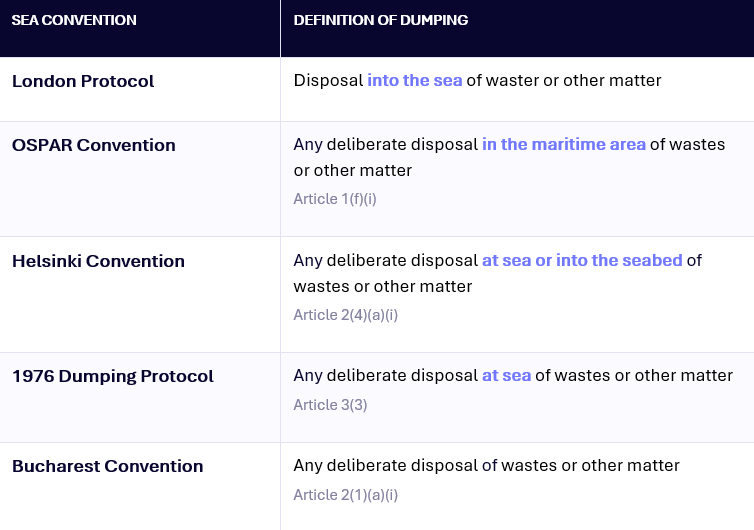
Table 2: Definitions of “dumping” under different international and regional conventions.
What this patchwork means for CCS deployment and the CO2 internal market
Europe's four sea basins are each on their own legal trajectory. The OSPAR Convention shows that a regional convention can adapt relatively swiftly to an activity its drafters did not envision, provided Contracting Parties have the political will to amend the text. The Barcelona and Bucharest treaties currently offer a permissive basis for offshore CO2 storage, while Helsinki's ongoing review reflects a genuine effort to resolve a long-standing interpretive question - one that should be followed by concrete action to remove the existing legal uncertainty.
This patchwork is a reminder that the legal and regulatory framework around offshore storage is inherently multilayered. For project developers, this means feasibility assessments must weigh national, EU, and international law together, not as separate silos.
As the EU CO2 market and transport infrastructure framework takes shape, this regional dimension deserves more than passing attention: legal certainty at the international level is a precondition for a genuinely coherent internal market for CO2.