On 17 July 2026, the European Commission issued its proposal for the EU ETS review, setting aside 260 million allowances to buy international credits. But where does that number come from?
The European Climate Law allows up to 5% of the EU's 1990 net GHG emissions to be met with high-quality international credits from 2036, as part of the 2040 target of a 90% emissions cut. This effectively lowers the domestic target from 90% to 85%. The ETS review extends the same logic to ETS sectors, which cover roughly 40% of total EU emissions.
Mechanically, this works through the Linear Reduction Factor (LRF), which sets how fast the ETS cap tightens each year:
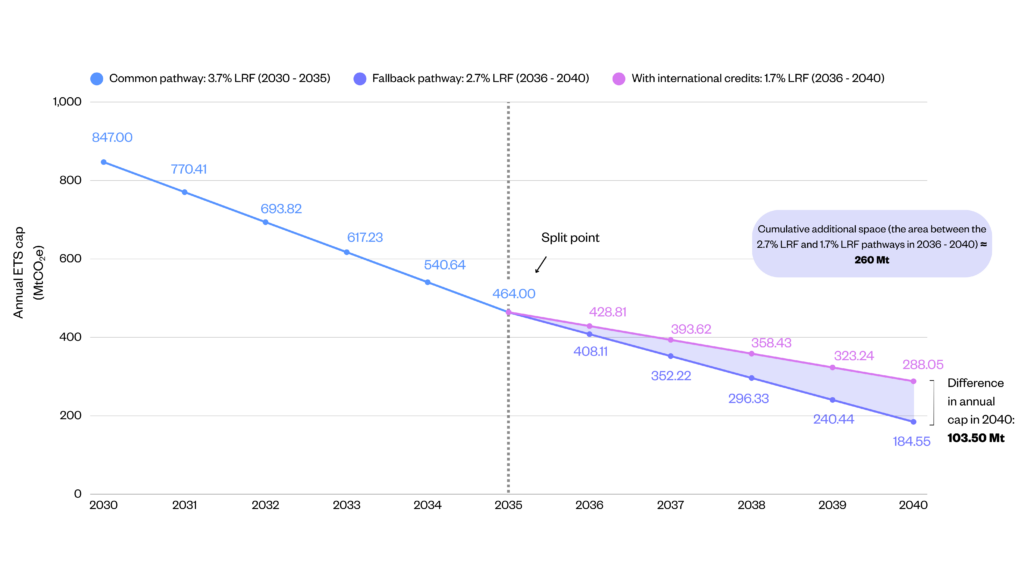
- 3.7%/year from 2031-2035 (common to all scenarios, marked in blue in the graphic)
- 2.7%/year fallback from 2036-2040, if the Commission's 2033 report finds sufficient credits aren't available (in purple in the graphic)
- 1.7%/year from 2036-2040, when combined with 260 Mt high-quality international credits (in pink in the graphic)
The gap between the 1.7% and 2.7% pathways, cumulated over 2036–2040, is the 260 Mt the Commission proposes to fund via a purchasing facility (Article 9b). This is sized to reflect ETS sectors' "fair share" of the additional emissions space created by the Climate Law's credit flexibility (Impact Assessment, Annex 8).
What hasn't been widely picked up: 260 Mt and 1.7% are the same commitment, expressed two ways, and the relationship works in both directions. Secure fewer credits, and the LRF shifts closer to the 2.7% fallback. For example, 180 Mt of credits would support an LRF of around 2.0%.
EU ETS review: Cap pathways under different Linear Reduction Factors (2030–2040)
Key assumptions:
- LRF-reference quantity = 2.07 Gt (based on PRIMES and POTEnCIA pathway points included in the Impact Assessment report, Annex 8, Section I.1)
- 2030 cap: 847 Mt
- LRFs apply as absolute annual reductions
Interpretation:
- The shaded area represents the cumulative additional domestic emissions space created by applying an LRF of 1.7% instead of 2.7% from 2036 to 2040.
- Area of triangle = ½ x base x height = ½ x 5 years x 103.5 Mt = 258.75 Mt ≈ 260 Mt
- This space is intended to be matched one-for-one by up to 260 Mt of international credits.
What happens next?
The Commission's proposal now enters the legislative process, where the European Parliament and the Council will examine the design of the purchasing facility, the role of high-quality international credits, and the future trajectory of the EU ETS cap. Understanding the relationship between the proposed 260 Mt of international credits and the corresponding Linear Reduction Factor is essential for interpreting the proposal and its implications for the carbon market.
Carbon Management Europe will continue to contribute evidence-based analysis throughout the negotiations. For a more detailed assessment, read our Position Paper on the EU ETS review and our reaction to the European Commission's proposal.